

GTA Real Estate: August 2026 Market Insights
GTA Real Estate, TRREB Market Report, August 2026, Affordable Housing
GTA Real Estate in August: Prices Slip, Inventory Shrinks, Opportunity Rises
The Greater Toronto Area housing market just delivered a loud message in August 2026: prices are falling, listings are shrinking, and serious buyers finally have leverage. For professionals watching Toronto housing trends and anyone chasing truly affordable options, this is not a time to sit on the sidelines. It’s a time to act strategically, with data and expert guidance on your side.
August Home Prices: The GTA Average Falls Back Under $1 Million
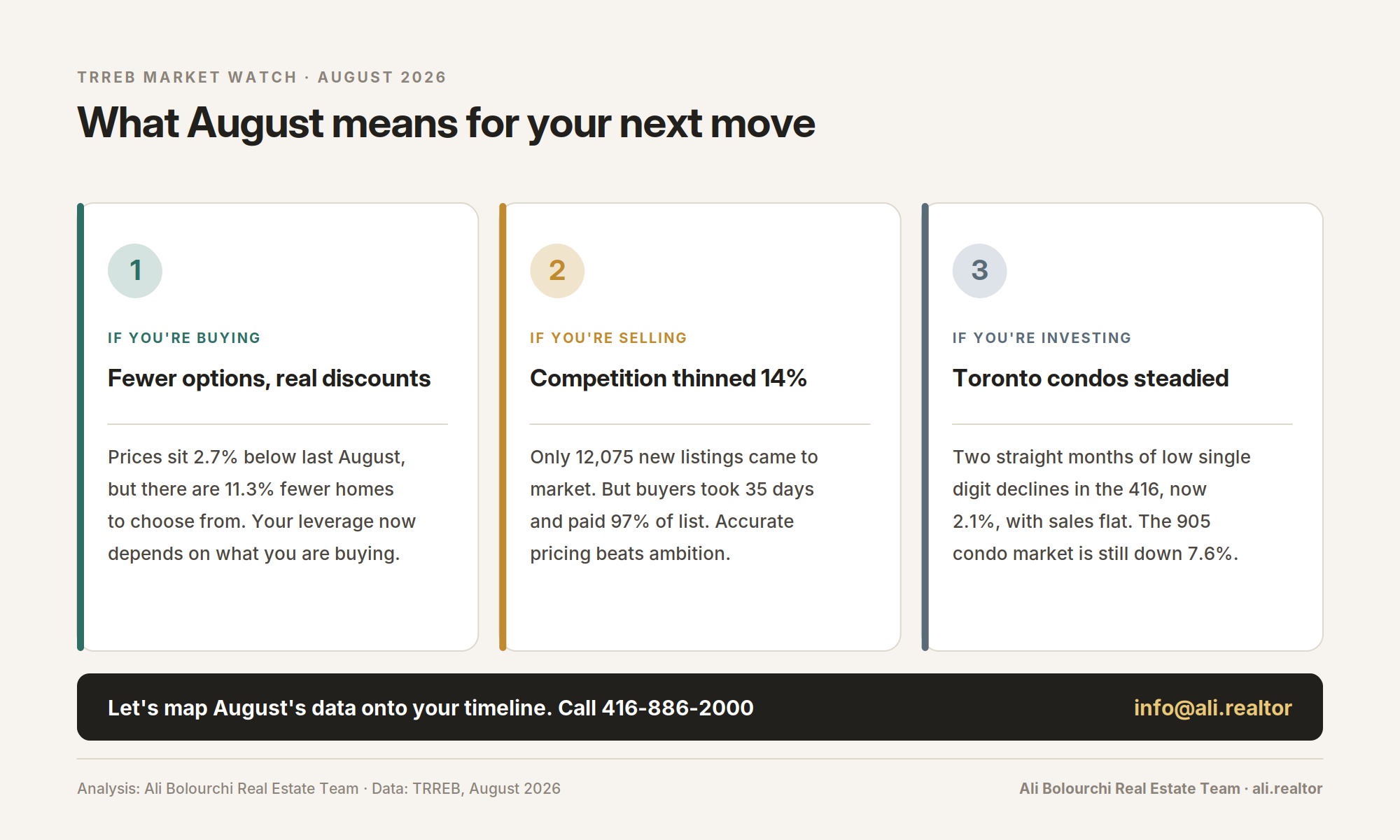
August 2026 marked a decisive psychological turning point: the average GTA home price slipped to $993,410, pushing the market back below the $1 million mark for only the second time this year, according to TRREB’s Market Watch and supporting data from WOWA and CityNews. That’s a 2.7% year-over-year drop, and the MLS® HPI Composite benchmark fell even harder, down 4.5% year-over-year to about $925,900.
Put bluntly, prices are rolling back to levels last seen around early 2021 and remain roughly 25% below the February 2022 peak of about $1.33 million. For first-time buyers and affordability-focused households, this isn’t just a headline—it’s a rare opening in a market that has punished hesitation for over a decade.
💡 Bold Insight: When average prices fall below $1M while mortgage rates stabilize, the math for first-time buyers changes dramatically. If you’ve been priced out since 2021, August’s numbers should have your full attention.
TRREB Market Report: Falling Prices, Falling Listings, Rising Leverage
The TRREB August 2026 Market Watch report lays out a market that is cooling—but not collapsing. GTA REALTORS® reported 5,057 sales, a modest 2.1% decline year-over-year. That alone wouldn’t be dramatic. The real story is on the supply side: new listings plunged 14.1% to 12,075, and active listings dropped 11.3% to about 24,482 properties.
Despite this pullback in inventory, the GTA is still sitting at roughly 4.6 months of supply—a clear buyer’s market by traditional definitions. The sales-to-new-listings ratio of about 37.5% remains below the 40–60% “balanced” range, confirming that buyers have the upper hand, even as listings thin out.

Price softness with thinning inventory is creating a rare tactical window for serious buyers.
The Paradox: Falling Prices and Falling Inventory at the Same Time
When prices fall, we usually expect inventory to swell as homes sit unsold. In August, the opposite happened: prices declined while both active and new listings also declined. This combination is powerful—and temporary.
For buyers: You’re still in a buyer’s market on paper, with leverage on price and conditions, but shrinking inventory means the best affordable listings won’t sit around. Waiting for a “crash” while supply contracts is a high-risk bet.
For sellers: There are fewer competing listings, but buyers are ruthless on pricing. Overpricing in this environment is a fast track to extended days on market and painful price cuts.
📌 Key Takeaway: Falling prices with falling inventory usually signals the market is searching for a bottom. When sentiment shifts or mortgage rates ease, this kind of supply backdrop can fuel a sharp rebound.
Market Segments in Focus: Detached, Semi-Detached, Townhouse, Condo
Not all property types are moving in lockstep. The August 2026 data shows a clear hierarchy of resilience—and a clear map for affordability seekers across the GTA.
Detached Homes: Resilient but Repriced
Detached homes still sit at the top of the price ladder, with an average of about $1,288,669 in August. That’s down only 1.8% year-over-year, making detached the most resilient segment in percentage terms. Sales have softened, but not collapsed, as many higher-income households simply adjusted expectations rather than exiting the market altogether.
Buyer insight: If you’ve been waiting for detached prices to “crater,” the data says that’s not happening—at least not yet. Instead, you’re being offered a strategic discount from peak prices plus stronger negotiating power on inspection, conditions, and closing timelines.
Seller insight: Detached sellers still command interest, but buyers are analytical. Sharp, data-backed pricing and professional presentation are non-negotiable if you want to avoid chasing the market down.
Semi-Detached: The Squeezed Middle
Semi-detached homes averaged around $931,665, with a steeper 4.9% year-over-year price drop. This segment is feeling pressure from both sides: buyers stretching for detached are trading up cautiously, while affordability-focused buyers are increasingly pulled toward townhouses and condos where entry prices are lower.
Buyer insight: Semis are often in established, transit-connected neighborhoods. The current discount relative to detached homes is widening—savvy buyers willing to renovate or compromise on lot size can capture serious long-term upside here.
Seller insight: You’re competing with both detached and townhouses. Your pricing and marketing must highlight lifestyle value—walkability, schools, and potential for secondary suites—to justify your ask.
Townhouses: The Affordability Workhorse
Freehold townhouses averaged about $882,060 in August, roughly flat year-over-year overall, but some sources show sharper declines in specific submarkets. Condo townhouses, at roughly $681,447, are down about 7.8% year-over-year, making them one of the hardest-hit categories in percentage terms.
This is where affordability and family living intersect. For many buyers, townhouses deliver the backyard, parking, and square footage of a low-rise home without the detached price tag. In a cautious economic climate, that combination is powerful.
Buyer insight: Townhouses—especially condo townhomes—are the quiet winners for affordability. The price corrections here are deeper, and competition is softer, opening the door for conditional offers and negotiation on fees and inclusions.
Seller insight: You’re in a value-sensitive segment. Pricing even 3–5% above market can stall your listing. Professional staging and clear communication of monthly costs (condo fees, utilities, taxes) can make or break your sale.
Condo Apartments: The Front Line of Affordable Housing
Condo apartments remain the entry point for many first-time buyers. August’s average of about $617,593 is down roughly 3.8% year-over-year, with other reports showing median condo prices in the GTA in the mid-$600,000s and softening through much of 2026 before stabilizing toward summer (Royal LePage, TRREB, WOWA).

Softer condo prices and longer days on market are empowering first-time buyers across the GTA.
Buyer insight: This is where the Affordable Homes and Condos story is most powerful. With prices off peak levels and days on market stretching into the mid-30s and beyond, buyers can negotiate on price, conditions, and even closing costs—especially with a data-driven agent in their corner.
Seller insight: The condo segment is competitive. A generic listing is invisible. You need sharp pricing, standout photography, and a digital marketing strategy that targets real buyers, not just casual browsers.
Sales Trends, Days on Market, and Negotiating Power
Beyond prices, the tempo of the market has shifted decisively. August transactions took roughly 35–51 days on average to firm up, depending on the data source. Compare that to the frantic, multiple-offer chaos of 2021 and early 2022, when homes vanished in days or even hours. Today, the market is slower, more deliberate, and far more analytical.
Fewer bidding wars and more conditional offers.
More room to negotiate on price, repairs, and closing dates.
Greater emphasis on pre-approvals, affordability, and long-term carrying costs.
💡 Pro Tip from the A.B.R.E. Team: In a market where average days on market are climbing, a well-structured offer with clean conditions and strong financing can beat a higher but weaker offer. Strategy now matters more than speed.
The Economic Backdrop: Employment, Inflation, and Mortgage Rates
Real estate doesn’t move in a vacuum. The GTA’s August performance is tightly linked to Canada’s broader economic story: steady but cautious employment, moderating inflation, and plateauing mortgage rates.
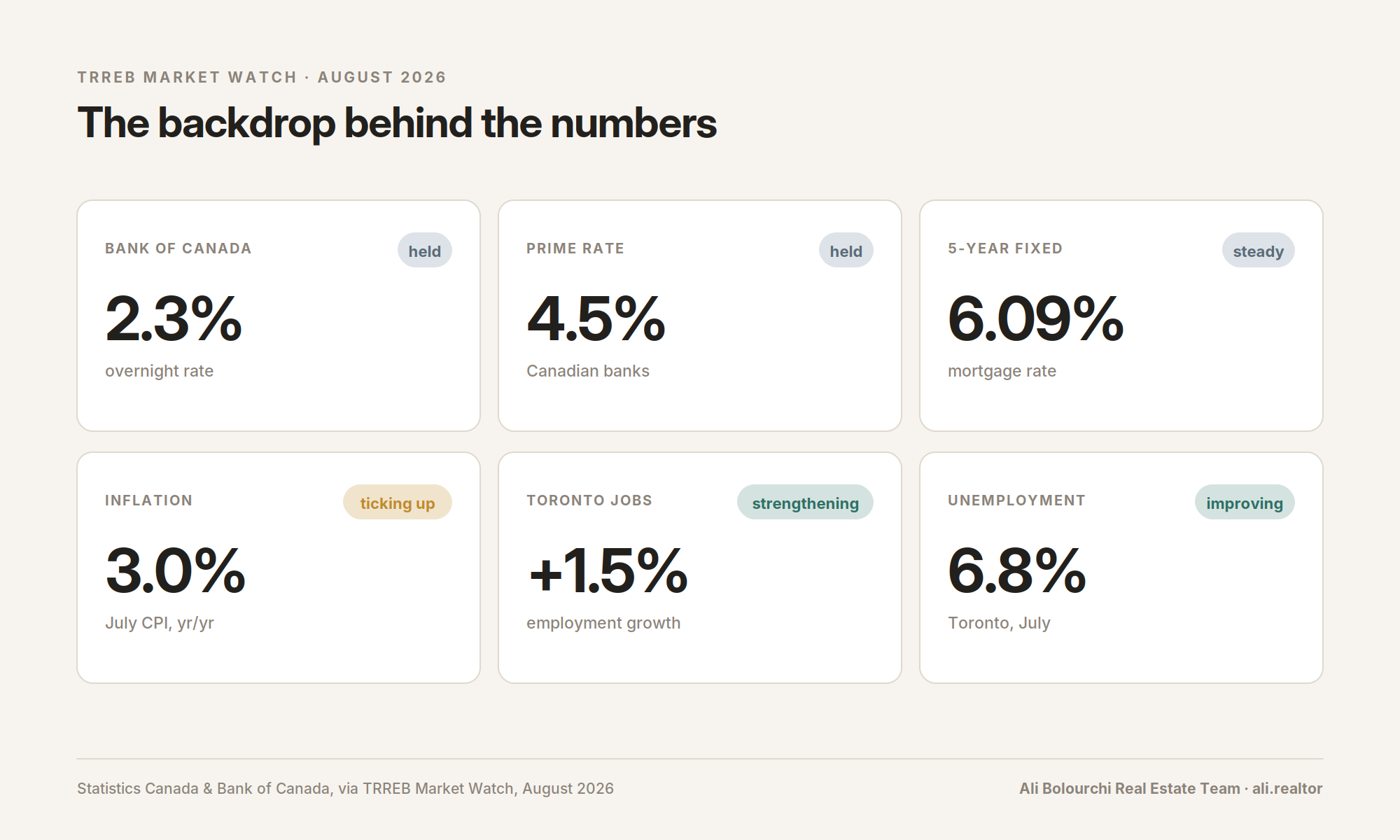
Employment across Ontario has remained relatively stable, but wage growth has not fully kept pace with the cost of living over the last few years. Inflation has cooled from its peak, but households are still feeling the pinch in groceries, transportation, and services. Mortgage rates, after climbing sharply in 2022–2023, have stabilized in a higher range, but without the constant shock of new hikes.
For buyers: Lower prices and stable rates mean improved relative affordability, but qualification remains tight. You need clean credit, realistic expectations, and a clear budget strategy.
For sellers: Buyers are payment-focused. They’re stress-testing their own budgets and walking away from homes that don’t pencil out. Your pricing must align with what today’s incomes and rates can support.
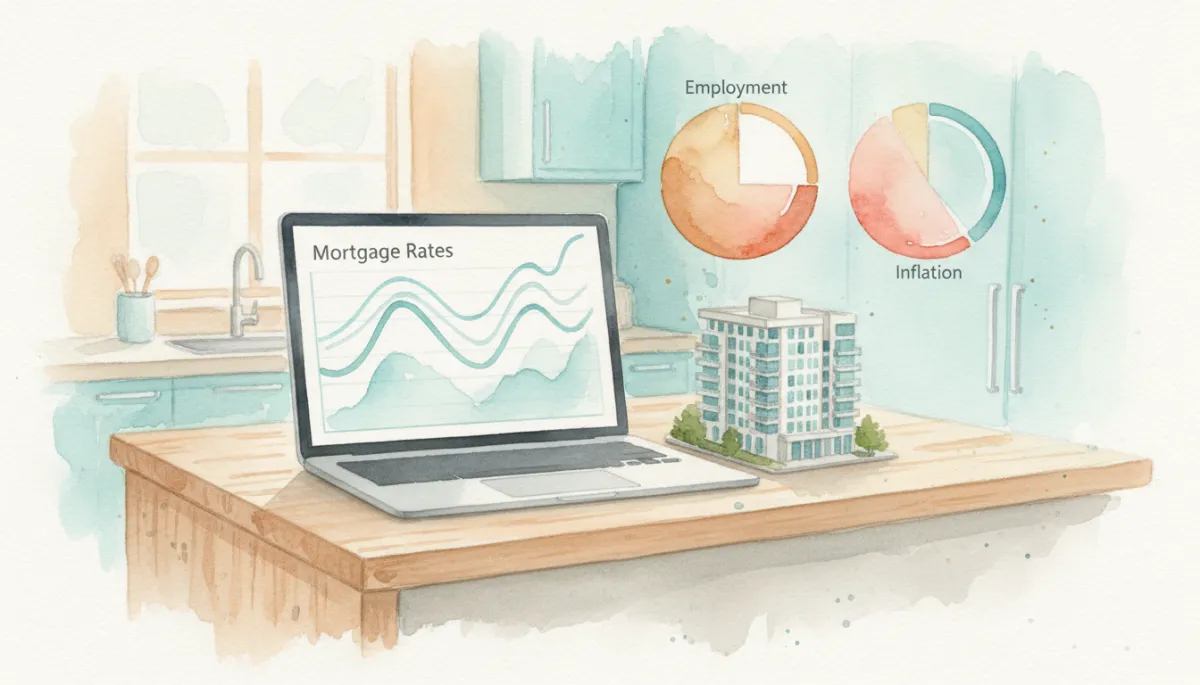
Moderating inflation and steady rates are reshaping what GTA households can realistically afford.
Toronto Housing Trends: From Frenzy to Calculated Opportunity
The August TRREB data and September trend updates point to a market in disciplined transition. The frenzy is gone. What’s left is a more rational environment where professionals, investors, and first-time buyers can make decisions anchored in evidence, not emotion.
Detached homes are holding value but no longer racing ahead.
Semi-detached and townhouses show sharper corrections—prime hunting grounds for move-up buyers and value seekers.
Condos remain the frontline of affordability, with softer pricing and longer marketing times.
📌 Professional Lens: For planners, developers, and policy professionals focused on Toronto housing trends, the message is clear: demand hasn’t disappeared—it’s recalibrating. Supply constraints and zoning barriers still loom large, and today’s dip in prices doesn’t erase long-term affordability challenges.
Affordable Housing in the GTA: Where the Real Openings Are
“Affordable housing” in Toronto has too often been an empty phrase. August 2026 doesn’t suddenly make the GTA cheap—but it does create pockets of genuine affordability that didn’t exist a year or two ago, especially for determined first-time buyers and downsizers willing to think strategically about location, property type, and timing.
Emerging neighborhoods with improving transit access and new mid-rise or condo developments.
Condo and condo-townhouse projects where investor selling is creating motivated listings.
Older, larger units in well-managed buildings that need cosmetic updates but offer serious square footage for the price.

Affordable opportunities are emerging in transit-served mid-rise corridors across the GTA.
This is exactly where the Affordable Homes and Condos - Ali Bolourchi Real Estate (A.B.R.E.) Team focuses its energy: identifying, analyzing, and negotiating on properties that truly move the needle for affordability-minded clients. With digital tools, real-time market data, and deep GTA neighborhood expertise, the A.B.R.E. Team is built to cut through the noise and surface real options—not wishful thinking.
What Buyers and Sellers Should Do Now
If You’re a First-Time or Affordable-Home Buyer
Get clarity on your eligibility. Start with a structured assessment, not guesswork. Take the A.B.R.E. Team’s free First-Time Home Buyer Eligibility Quiz to understand what you can realistically afford in today’s market.
Target segments with real softness. Condos, condo townhouses, and selected townhouse communities are where price corrections and negotiability are strongest right now.
Use data to your advantage. Work with a team that can show you TRREB and neighborhood-level stats in real time, not just anecdotes from open houses.
If You’re a Seller in This Market
Price with precision, not pride. The August TRREB report is clear: overpricing in a buyer-leaning market is punished, not rewarded. Buyers have options and data at their fingertips.
Invest in presentation and digital reach. Professional photos, staging, and targeted online marketing are now baseline requirements, not luxuries, especially for condos and townhomes.
Leverage expert guidance. The A.B.R.E. Team’s seller guides and digital tools help you understand where your property sits in the current price spectrum—before you hit the market.
Move from Uncertainty to Action with the A.B.R.E. Team
August’s GTA numbers are not a reason to panic. They are a reason to get serious. The combination of average prices under $1 million, declining listings, and a buyer-tilted but tightening market will not last indefinitely. When confidence returns or mortgage rates ease, today’s “softness” can turn into tomorrow’s surge.
The Affordable Homes and Condos - Ali Bolourchi Real Estate (A.B.R.E.) Team exists for this exact moment—when information overload and market noise can freeze even the most motivated buyers and sellers. With a commitment to transparency, client empowerment, digital innovation, and deep GTA expertise, the team is ready to help you turn August’s market shift into your personal opportunity.
Take the free First-Time Home Buyer Eligibility Quiz to see where you stand today.
Browse curated affordable homes and condos across the GTA, filtered by price, transit access, and lifestyle.
Download the free buyer’s and seller’s guides for step-by-step strategies tailored to this market cycle.
Contact the A.B.R.E. Team for a personalized consultation grounded in real TRREB data, not guesses.
GTA real estate in August 2026 is bold, complex, and full of signals. With the right partner, those signals can become a clear, confident plan. The window is open—step through it before the market moves on without you.