
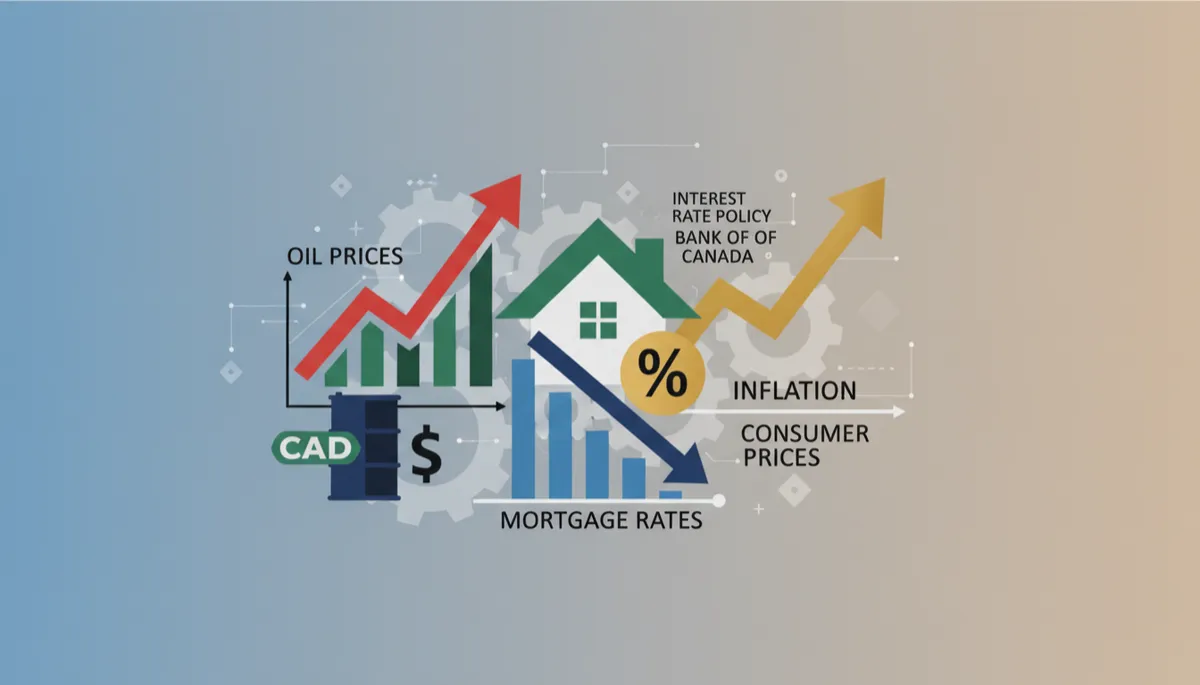
Impact of Canada's Rate on Mortgages & Real Estate
Bank Of Canada, Mortgage Rates, Canadian Inflation, Oil Prices, Real Estate Market, Interest Rate Policy
What the Bank of Canada’s 2.25% Policy Rate and Rising Oil Prices Mean for Mortgage Rates and the Real Estate Market
The Bank of Canada’s decision to hold its policy interest rate at 2.25%—even as oil prices climb roughly 20%—is reshaping mortgage dynamics and the broader Canadian economy. For buyers, sellers, and investors in the Greater Toronto Area (GTA), understanding how Oil Prices, Canadian Inflation, and Interest Rate Policy intersect is essential for making confident real estate decisions today.
1. The Bank of Canada at 2.25%: Why a Pause Matters
On September 2, 2026, the Bank Of Canada held its overnight policy interest rate at 2.25%, with the Bank Rate at 2.50% and the deposit rate at 2.20%. This decision effectively anchors the benchmark for short-term borrowing costs in Canada and helps set the tone for lenders’ Prime rates, which currently sit around 4.45% in major institutions.
For businesses, agencies, and real estate clients across the GTA, this pause signals that the Bank of Canada is attempting to balance two competing forces: still-elevated Canadian Inflation risks and a housing and credit market that needs stability to support growth. A steady policy rate provides some predictability for Mortgage Rates, especially variable-rate products tied closely to Prime, while the Bank evaluates how new economic data—especially on energy and consumer prices—evolves over the coming months.
📌 Key Takeaway: A 2.25% policy rate keeps borrowing costs moderate by historical standards, but it also leaves room for the Bank of Canada to move quickly if inflation, driven in part by energy, accelerates again.
2. A 20% Surge in Oil Prices: The New Inflation Wildcard
At the same time, global Oil Prices have surged. Recent data show WTI crude trading in the low $100s per barrel, up sharply from the mid‑$80s at the start of the month—a move of roughly 20% in a short period. Brent crude has climbed as well, with spot prices above $120 per barrel on recent trading days. This is not a minor fluctuation; it is a structural cost shock that ripples through the Canadian economy, particularly in transportation, manufacturing, and logistics-heavy sectors that serve the GTA and beyond.
For a country like Canada—both an energy producer and a major consumer—rising Oil Prices create a complex backdrop. While higher energy revenues can support certain regions and sectors, they also put upward pressure on consumer prices nationwide. That pressure is especially visible in fuel, utilities, and the cost of moving goods across the supply chain, all of which feed directly into Canadian Inflation metrics that the Bank of Canada monitors closely.

A 20% rise in Oil Prices can quickly filter into both inflation data and borrowing costs.
3. How Oil Prices Flow Through to Consumer Prices and Inflation
Energy is a foundational input for nearly every good and service in the modern economy. When Oil Prices rise, transportation firms pay more for fuel, manufacturers face higher costs for shipping inputs and finished goods, and even digital businesses experience indirect increases through their service providers. These higher costs rarely stay on corporate balance sheets for long; they are typically passed on to households and businesses through higher consumer prices.
This is where the connection to Canadian Inflation becomes clear. Energy components feed directly into headline inflation, but they also influence “core” measures by raising the cost of food, building materials, transportation services, and even home heating. As energy costs climb, the overall basket of goods and services priced by Statistics Canada begins to reflect this pressure, which can keep inflation above the Bank of Canada’s 2% target even when other categories are cooling.
💡 Pro Tip for Businesses and Agencies: When budgeting for the next 12–24 months, build in scenarios where elevated energy costs keep inflation stubbornly above 2%. This helps you stress‑test project budgets, marketing plans, and real estate strategies.
4. How Energy Costs Shape Bank of Canada Interest Rate Policy
The Bank of Canada’s Interest Rate Policy is ultimately designed to keep inflation near its 2% target over the medium term. When Oil Prices jump 20% in a compressed timeframe, policymakers must decide whether this is a temporary spike or the start of a sustained trend that will embed itself into wages and long‑term price expectations. That assessment drives whether they maintain, cut, or raise the policy rate from its current 2.25% level.
If energy-driven inflation appears temporary, the Bank of Canada can justify holding rates steady, as it has done, to support growth and financial stability. But if higher energy costs begin to lift wage demands, long-term inflation expectations, or housing-related costs, the Bank may feel compelled to tighten policy despite slower growth. That would mean higher borrowing costs for households, including those taking on or renewing mortgages in the Real Estate Market across the GTA.
5. Fixed vs. Variable Mortgage Rates: The Role of Bond Yields and Oil Prices
While the policy rate and Prime rate are central to the conversation, different types of Mortgage Rates respond to different market forces. Understanding this distinction is crucial for buyers, sellers, and advisors in the GTA who are trying to time decisions in a shifting environment.
Variable Mortgage Rates: Tethered to the Bank of Canada and Prime
Variable mortgage rates are typically expressed as a discount or premium to the lender’s Prime rate, which in turn tracks the Bank of Canada’s overnight rate. With the policy rate at 2.25% and Prime around 4.45%, we are currently seeing 5‑year variable rates in the 3.45%–3.95% range, depending on insurance status and borrower profile. Three‑year variables are closer to 3.90% in many cases.
When Oil Prices rise and inflation risks increase, markets may begin to price in future Bank of Canada rate hikes. Even if the Bank has not yet moved, lenders can adjust their variable-rate discounts to reflect this risk. As a result, a sustained oil-driven inflation story can eventually push variable Mortgage Rates higher, especially if the Bank signals that future tightening is on the table to keep Canadian Inflation under control.
Fixed Mortgage Rates: Driven by Government of Canada Bond Yields
Fixed-rate mortgages, particularly 3‑ to 5‑year terms, are more directly influenced by mid‑ to long‑term Government of Canada bond yields than by the overnight policy rate itself. Lenders use bond yields as a baseline for their funding costs and add a spread to arrive at final fixed Mortgage Rates. When investors anticipate higher inflation or more aggressive future rate hikes—often in response to rising Oil Prices and energy-related inflation—they demand higher yields on those bonds, which in turn pushes fixed rates higher.
As of mid‑September 2026, benchmark fixed Mortgage Rates across Canada are generally in the 3.69%–4.64% range, depending on term and insurance status. In Ontario, insured 5‑year fixed rates at major banks are hovering around 4.19%, with some broker-sourced offers for shorter terms closer to 3.69%. If bond yields continue to respond to higher inflation expectations driven by energy, these fixed rates could drift upward, even if the Bank of Canada keeps its policy rate unchanged for a time.

Fixed Mortgage Rates tend to move with Government of Canada bond yields, not just the policy rate.
6. The Broader Economic Impact: From Business Costs to Real Estate Demand
For businesses and agencies, a combination of steady policy rates and rising Oil Prices creates a mixed environment. On one hand, borrowing costs remain relatively attractive compared with historical norms, supporting investment in technology, marketing, and real estate. On the other, elevated energy and transportation costs compress margins and may limit the appetite for expansion or relocation, especially into higher‑cost urban markets like the GTA.
In the Real Estate Market, this tension shows up in nuanced ways. Some buyers accelerate purchases to lock in today’s Mortgage Rates before any potential increase. Others pause, worried that higher inflation and living costs will strain household budgets. Investors weigh rising rents and long‑term housing demand against higher financing and operating costs. For first-time home buyers and affordable home seekers—the primary focus of Affordable Homes and Condos - Ali Bolourchi Real Estate (A.B.R.E.) Team—this environment demands careful, data-driven guidance.

In a shifting rate and inflation environment, affordability hinges on precise budgeting and advice.
7. Strategic Actions: Buying, Renewing, or Selling Property in Today’s Market
For Buyers: Lock in Clarity, Not Just a Rate
If you are considering a purchase in the GTA, the current environment offers a window of opportunity. With the Bank of Canada holding at 2.25% and both fixed and variable Mortgage Rates still in the mid‑3% to low‑4% range, many households can qualify for more than they might if rates rise further in response to persistent energy-driven inflation. However, the risk of higher living costs means affordability should be assessed conservatively, not optimistically.
Consider a shorter-term fixed rate (e.g., 3‑year) if you believe rates may decline after inflation normalizes, but want protection from near‑term volatility driven by Oil Prices and bond yields.
Evaluate a variable rate if you have financial flexibility and are comfortable with potential increases tied to future Bank of Canada decisions.
Build a budget that accounts for higher utilities, transportation, and condo fees, recognizing that energy costs can influence all three.
The A.B.R.E. Team’s digital tools—such as affordability calculators and curated listings of affordable homes and condos—can help you stress‑test scenarios under different Mortgage Rates and inflation assumptions before you commit to a purchase.
For Homeowners Renewing: Use the Rate Gap to Your Advantage
Many GTA homeowners are currently renewing mortgages that were locked in at higher rates several years ago. With today’s renewal offers often in the 3.4%–3.99% range, there is an opportunity to reduce monthly payments or shorten amortization—even in a world of higher Oil Prices and inflation uncertainty. However, renewal is also a chance to rethink your strategy in light of evolving Interest Rate Policy.
Do not accept the first renewal offer from your lender. Shop around or work with a professional team to compare options across banks and brokers.
If you expect energy-driven inflation to persist, a fixed rate may provide peace of mind, even if variable rates start slightly lower today.
Consider aligning your mortgage term with your life plans—for example, a 3‑year term if you may sell or upgrade in the near future.
For Sellers and Investors: Timing and Positioning Are Critical
Sellers in the GTA are operating in a market where buyers are highly sensitive to monthly payments, not just sticker prices. As Mortgage Rates move in response to bond yields and Bank of Canada signals, affordability bands shift, which can affect demand for specific price points and neighbourhoods. Rising Oil Prices and inflation may also push some renters to stay put longer, while encouraging others to buy now before costs climb further.
Work with an agent who understands how rate changes translate into buyer affordability and can price your home or condo accordingly.
Highlight energy-efficient features—such as upgraded windows, insulation, or efficient HVAC systems—as buyers become more cost-conscious about utilities.
Investors should model higher operating costs (insurance, utilities, condo fees) alongside realistic rent growth, rather than assuming past trends will continue unchanged.

Strategic pricing and clear communication of costs are essential for successful sales in today’s market.
8. How the A.B.R.E. Team Helps You Navigate This Environment
In a market shaped by a 2.25% Bank of Canada policy rate, rising Oil Prices, and evolving Interest Rate Policy, clarity becomes a competitive advantage. Affordable Homes and Condos - Ali Bolourchi Real Estate (A.B.R.E.) Team is dedicated to providing that clarity for first-time home buyers, affordable home seekers, and investors across the Greater Toronto Area.
Grounded in transparency, digital innovation, and deep expertise in the Real Estate Market, the team combines real-time data on Mortgage Rates, Canadian Inflation, and neighbourhood trends with personalized advice. Whether you are buying, renewing, or selling, the goal is to empower you with the information and tools needed to make decisions that align with your financial goals and risk tolerance in a period of heightened energy and price volatility.
9. Next Steps: Turn Market Complexity into Opportunity
The interaction between the Bank of Canada’s 2.25% policy rate, a 20% increase in Oil Prices, and shifting Mortgage Rates is complex—but it does not need to be overwhelming. With the right guidance, you can position your household or your business to benefit from today’s conditions while preparing for tomorrow’s uncertainties. Energy costs will continue to influence inflation and, by extension, Interest Rate Policy, but proactive planning can turn that reality into a strategic advantage rather than a source of stress.
To explore your options in detail:
Take the free First-Time Home Buyer Eligibility Quiz to understand what you can comfortably afford in today’s rate and inflation environment.
Browse curated affordable homes and condos across the GTA that align with your budget and lifestyle needs.
Download the free buyer’s and seller’s guides for practical checklists, budgeting frameworks, and negotiation tips tailored to the current market.
Contact the A.B.R.E. Team for a personalized consultation that integrates Bank of Canada policy, bond yields, and local Real Estate Market data into a clear, actionable plan.
In a time when Oil Prices, Canadian Inflation, and Interest Rate Policy are in constant motion, having a trusted, data‑driven partner on your side can make all the difference. The Affordable Homes and Condos - Ali Bolourchi Real Estate (A.B.R.E.) Team is committed to helping you navigate this landscape with confidence, clarity, and a focus on securing the best possible outcome for your real estate journey in the Greater Toronto Area.