
Bank of Canada Deliberations: What December 9 Means for GTA Buyers, Sellers and Investors
If you are deciding whether to buy, sell or invest in the GTA before the new year, one date matters more than most: December 9, when the Bank of Canada makes its next rate announcement. On November 10 the Bank published a summary of what its Governing Council debated before it raised the overnight rate on October 28. Here is what that summary says, in plain words, and what each of the two likely outcomes could mean for you.
Nobody explains central bank language at the kitchen table, and that is the problem, not you. I read the Bank's own documents next to the October TRREB report so you do not have to. This is market analysis and scenarios, not a prediction. I do not know what the Bank will do on December 9, and neither does anyone else.
What the Bank of Canada said
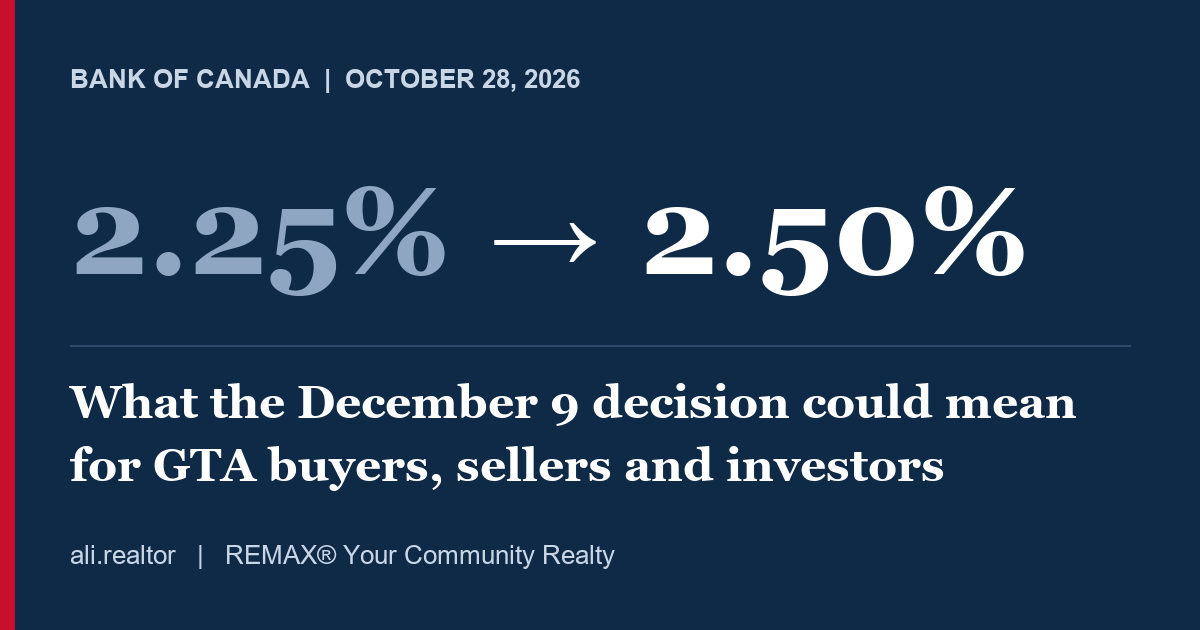
- The decision. On October 28 the Bank raised its target for the overnight rate by 25 basis points, from 2.25% to 2.50%, with the Bank Rate at 2.75% and the deposit rate at 2.45% (press release). The new summary says members had also considered holding at 2.25%. News coverage described it as the Bank's first increase in more than three years.
- The reason. Higher energy prices have kept total inflation around 3% since April. Businesses face rising costs for fuel, imported goods and AI-related components, and survey evidence suggests they plan to pass more of it on. The economy is also proving more resilient than expected, so there is less slack to absorb those costs. Council members said policy cannot lower global energy prices, but it can reduce the risk that those prices spread into everything else.
- The outlook. The Bank projects inflation reaching about 3.5% by the end of 2026, staying above 3% through much of 2027, and returning to its 2% target around the middle of 2028. It expects growth of 1% in 2026 and 2% in 2027 and 2028.
- The warning. Members said further increases could be needed. They will decide one meeting at a time on the best information available, and they stressed that uncertainty is not a reason to do nothing.
- What they cannot see. The war in the Middle East, Canada-U.S. trade, global financial conditions, how fast and how far costs pass through to prices, and how households and businesses react.
Source: Bank of Canada, Summary of Governing Council Deliberations, published November 10, 2026. For what the October 28 hike means for mortgage payments and renewals, see my earlier post: What the Bank of Canada's October 28 Rate Hike Really Means for GTA Homeowners.
What has happened since the decision
The data since October 28 has been softer than the Bank described, which is why December is a real question.
- Growth. Statistics Canada reported that GDP was essentially unchanged in August, the second flat month in a row, and its early estimate for September is a 0.1% decline. That points to third-quarter growth of about 1.3% annualized, below the 2% the Bank expected (BNN Bloomberg, October 30).
- Jobs. Employment fell by about 42,000 in August and 68,000 in September, then slipped by about 4,700 in October. The unemployment rate rose to 6.7% from 6.5% (Statistics Canada, November 6).
- Expectations are split. As of October 30, market pricing put the odds of a December hike at 57%, before the October jobs report. CIBC's Andrew Grantham said the weak data supports a pause in December, while RSM's Tu Nguyen called December versus January a coin flip (BNN Bloomberg). Those are their views, not the Bank's.
The GTA market these decisions land on
TRREB's October report shows a market where buyers are cautious and sellers are listing less (TRREB Market Watch, October 2026):
- Home sales: 5,603, down 7.9% from October 2025.
- New listings: 14,173, down 11.9%. Active listings: 25,098, down 10.0%.
- Average selling price: $1,024,108, down 2.7%. The MLS® HPI Composite benchmark is down 4.3%.
- Months of inventory: 4.6. Homes sold for an average of 97% of the asking price, after an average of 31 days on the market.
TRREB notes that monthly payments on an average-priced home have edged up from a year ago but remain much lower than in 2023 and 2024, and that lower selling prices have offset part of the rise in borrowing costs. For the city-versus-suburb detail, see Toronto Holds Its Ground: October Prices Firm Up in the City While the Suburbs Slide.
Two ways December 9 could go
I am not forecasting either one. Plan for both.
| If the Bank raises to 2.75% | If the Bank holds at 2.50% | |
|---|---|---|
| Buyers | Variable-rate payments and lines of credit rise right away. Budgets tighten a little more, which adds to buyer caution. | Variable-rate payments stay put. The Bank may still signal more increases, so fixed rates will not necessarily fall. |
| Sellers | A thinner pool of buyers who are comparing every listing. Pricing to the current market matters more. | A little more certainty for buyers, which could help sentiment. Fewer competing listings still work in your favour. |
| Investors | Financing costs rise, which squeezes cash flow on leveraged purchases and raises the bar for any deal. | Financing costs hold for now, but the Bank has said more may be needed, so deals still have to work at a higher rate. |
The next scheduled announcement after December 9 is January 27, 2027 (Bank of Canada schedule), so a hold in December does not close the door on a hike in the new year.
If you are buying
Your leverage is real: homes are selling for about 97% of asking, there are 4.6 months of inventory, and prices are below last year. What the Bank changes is your payment, not that leverage.
- Know which rate you have. Variable-rate mortgages and lines of credit follow the overnight rate. Fixed rates follow bond yields, which move on expectations, often before the Bank announces anything. A hold on December 9 does not guarantee lower fixed rates, and a hike may already be partly built in.
- Look at the size of the move. As an illustration only, on a $500,000 mortgage over 25 years, each quarter-point (starting from about 4%) adds roughly $70 a month. On an $819,000 mortgage, which is 20% down on October's average price of $1,024,108, it is roughly $112 a month. Your numbers will differ.
- Test your budget one point higher. If a payment only works at today's rate, ask your mortgage professional how it looks 1 percentage point higher before you make an offer.
Rates and qualification are your mortgage professional's territory, so talk to one before you commit. The mortgage calculator on this site is a good place to start the math.
If you are selling
You have fewer competing listings than last October (down 11.9% for new listings, 10.0% for active), but also fewer buyers (sales down 7.9%). About four in ten new listings found a buyer in October (sales divided by new listings is 39.5%), so demand exists, and it is price-aware.
- Price for the buyer you will actually meet. Buyers are running their numbers against today's rates, and a hike makes them more careful. A price set to the current market from day one usually does better than a price you cut later.
- Look at both sides of your move. If you are also buying, a rate change affects the home you are buying as well as the buyer of yours. Plan the two together.
- Know your real number. A home evaluation based on recent sales on your street tells you far more than a headline average.
If you are investing
For leveraged investors the swing factor is the cost of money, not the headline price.
- Underwrite at a higher rate than you have today. The Bank has said further increases could be needed and expects inflation above 3% through much of 2027. A deal that only works at today's financing cost has little room for error.
- Entry prices are softer, demand is thinner. In October the average condo apartment price fell 5.6% in Toronto (to $659,214) and 6.1% in the 905 (to $539,094), and condo apartment sales fell 10.4% across the GTA. Lower prices help the entry point, but fewer buyers can mean a longer wait to sell or re-lease.
- Count every cost. Higher inflation also lifts the cost of insurance, repairs and property tax, so leave margin in the numbers.
Nothing here is a projected return or a guarantee. Check your numbers with your accountant and your mortgage professional.
What we are watching before December 9
- The next jobs report and the October inflation reading. Both are normally published before the Bank's December meeting, and the Bank has named inflation and cost pass-through as its main concern.
- Statistics Canada's September GDP and official third-quarter figures, due this month, to see whether the 1.3% estimate holds.
- Energy prices and the Middle East. The Bank's inflation projection starts with energy.
- Canada-U.S. trade news. The Bank lists it as a major uncertainty, and TRREB's president says a trade deal could give GTA residents a clearer outlook.
- Five-year bond yields. Fixed mortgage rates follow them, so they often move before the Bank does.
- TRREB's November report in early December, to see whether buyers and sellers changed course.
Where do you want to be by spring?
Whichever way December 9 goes, the cost of waiting without a plan is the same: you stretch into a payment that owns you, or you miss the window you could have used. The fix is simple:
- Tell me your goal and your timeline. Buying, selling, or investing.
- I show you the numbers for your property type and your street, including what it really costs to carry at today's rate and at a higher one.
- You decide with a plan, not a guess, with your mortgage professional alongside.
Call 416-886-2000 to book a call. Not ready to talk yet? Run your numbers in the mortgage calculator first.
Ali Bolourchi, Broker
REMAX® Your Community Realty
Phone: 416-886-2000
Email: [email protected]
Websites: ali.realtor | GTALuxuryHomes.ca | The4Sale.com
Sources: Bank of Canada, Summary of Governing Council Deliberations (November 10, 2026) and press release (October 28, 2026); Statistics Canada, Labour Force Survey (November 6, 2026); BNN Bloomberg on August GDP (October 30, 2026); Toronto Regional Real Estate Board (TRREB) Market Watch, October 2026. Sales divided by new listings is calculated from the TRREB figures. Payment illustrations assume a 25-year amortization and are examples only. This article is general market information and analysis, not financial, mortgage or investment advice, and it does not predict what the Bank of Canada will do. Speak with a licensed mortgage professional about your own situation. It is not intended to solicit buyers or sellers currently under contract with a brokerage.